 Add to Chrome
 Add to Firefox
 Add to Edge
HumanNOVA: Photorealistic, Universal and Rapid 3D Human Avatar Modeling from a Single Image
Jun 01, 2026
In this paper, we present HumanNOVA, a photorealistic, universal, and rapid model for generating 3D human avatars from a single RGB image. Achieving both photorealism and generalization is challenging due to the scarcity of diverse, high-quality 3D human data. To address this, we build a scalable data generation pipeline that follows two strategies. The first one is to leverage existing rigged assets and animate them with extensive poses from daily life. The second strategy is to utilize existing multi-camera captures of humans and employ fitting to generate more diverse views for training. These two strategies enable us to scale up to 100k assets, significantly enhancing both the quantity and the diversity of data for robust model training. In terms of the architecture, HumanNOVA adopts a feed-forward, token-conditioned avatar modeling framework that allows fast inference in less than one second and requires no test-time optimization. Given an input image and an estimated simplified human mesh (SMPL) without detailed geometry or appearance, the model first encodes both inputs into compact token representations. These tokens then act as conditioning signals and are fused through cross-attention to construct a triplane-based 3D avatar representation. Extensive experiments on multiple benchmarks demonstrate the superiority of our approach, both quantitatively and qualitatively, as well as its robustness under diverse input image conditions. Project page at https://HumanNOVA.github.io .

HiFi-Inpaint: Towards High-Fidelity Reference-Based Inpainting for Generating Detail-Preserving Human-Product Images
Mar 03, 2026Human-product images, which showcase the integration of humans and products, play a vital role in advertising, e-commerce, and digital marketing. The essential challenge of generating such images lies in ensuring the high-fidelity preservation of product details. Among existing paradigms, reference-based inpainting offers a targeted solution by leveraging product reference images to guide the inpainting process. However, limitations remain in three key aspects: the lack of diverse large-scale training data, the struggle of current models to focus on product detail preservation, and the inability of coarse supervision for achieving precise guidance. To address these issues, we propose HiFi-Inpaint, a novel high-fidelity reference-based inpainting framework tailored for generating human-product images. HiFi-Inpaint introduces Shared Enhancement Attention (SEA) to refine fine-grained product features and Detail-Aware Loss (DAL) to enforce precise pixel-level supervision using high-frequency maps. Additionally, we construct a new dataset, HP-Image-40K, with samples curated from self-synthesis data and processed with automatic filtering. Experimental results show that HiFi-Inpaint achieves state-of-the-art performance, delivering detail-preserving human-product images.
Controlling Your Image via Simplified Vector Graphics
Feb 16, 2026Recent advances in image generation have achieved remarkable visual quality, while a fundamental challenge remains: Can image generation be controlled at the element level, enabling intuitive modifications such as adjusting shapes, altering colors, or adding and removing objects? In this work, we address this challenge by introducing layer-wise controllable generation through simplified vector graphics (VGs). Our approach first efficiently parses images into hierarchical VG representations that are semantic-aligned and structurally coherent. Building on this representation, we design a novel image synthesis framework guided by VGs, allowing users to freely modify elements and seamlessly translate these edits into photorealistic outputs. By leveraging the structural and semantic features of VGs in conjunction with noise prediction, our method provides precise control over geometry, color, and object semantics. Extensive experiments demonstrate the effectiveness of our approach in diverse applications, including image editing, object-level manipulation, and fine-grained content creation, establishing a new paradigm for controllable image generation. Project page: https://guolanqing.github.io/Vec2Pix/
Improving Flexible Image Tokenizers for Autoregressive Image Generation
Jan 04, 2026Flexible image tokenizers aim to represent an image using an ordered 1D variable-length token sequence. This flexible tokenization is typically achieved through nested dropout, where a portion of trailing tokens is randomly truncated during training, and the image is reconstructed using the remaining preceding sequence. However, this tail-truncation strategy inherently concentrates the image information in the early tokens, limiting the effectiveness of downstream AutoRegressive (AR) image generation as the token length increases. To overcome these limitations, we propose \textbf{ReToK}, a flexible tokenizer with \underline{Re}dundant \underline{Tok}en Padding and Hierarchical Semantic Regularization, designed to fully exploit all tokens for enhanced latent modeling. Specifically, we introduce \textbf{Redundant Token Padding} to activate tail tokens more frequently, thereby alleviating information over-concentration in the early tokens. In addition, we apply \textbf{Hierarchical Semantic Regularization} to align the decoding features of earlier tokens with those from a pre-trained vision foundation model, while progressively reducing the regularization strength toward the tail to allow finer low-level detail reconstruction. Extensive experiments demonstrate the effectiveness of ReTok: on ImageNet 256$\times$256, our method achieves superior generation performance compared with both flexible and fixed-length tokenizers. Code will be available at: \href{https://github.com/zfu006/ReTok}{https://github.com/zfu006/ReTok}
Demystifying the Visual Quality Paradox in Multimodal Large Language Models
Jun 18, 2025Recent Multimodal Large Language Models (MLLMs) excel on benchmark vision-language tasks, yet little is known about how input visual quality shapes their responses. Does higher perceptual quality of images already translate to better MLLM understanding? We conduct the first systematic study spanning leading MLLMs and a suite of vision-language benchmarks, applying controlled degradations and stylistic shifts to each image. Surprisingly, we uncover a visual-quality paradox: model, task, and even individual-instance performance can improve when images deviate from human-perceived fidelity. Off-the-shelf restoration pipelines fail to reconcile these idiosyncratic preferences. To close the gap, we introduce Visual-Quality Test-Time Tuning (VQ-TTT)-a lightweight adaptation module that: (1) inserts a learnable, low-rank kernel before the frozen vision encoder to modulate frequency content; and (2) fine-tunes only shallow vision-encoder layers via LoRA. VQ-TTT dynamically adjusts each input image in a single forward pass, aligning it with task-specific model preferences. Across the evaluated MLLMs and all datasets, VQ-TTT lifts significant average accuracy, with no external models, cached features, or extra training data. These findings redefine ``better'' visual inputs for MLLMs and highlight the need for adaptive, rather than universally ``clean'', imagery, in the new era of AI being the main data customer.
Person Recognition at Altitude and Range: Fusion of Face, Body Shape and Gait
May 07, 2025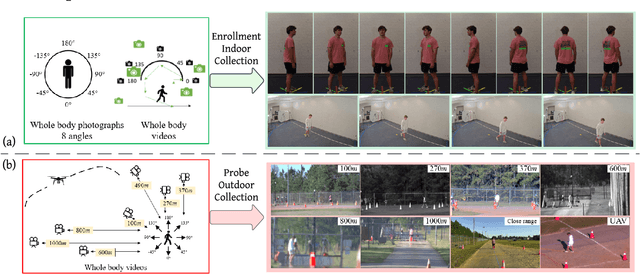
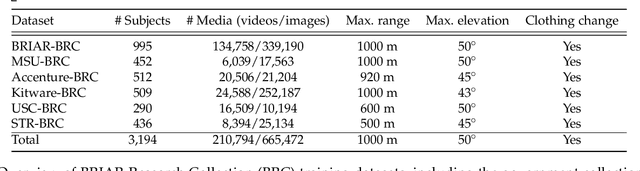
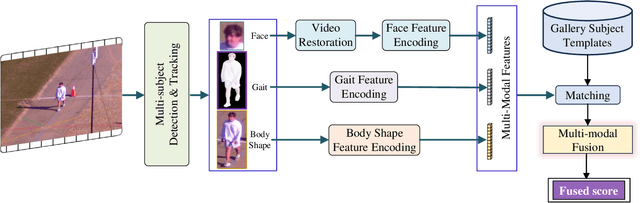
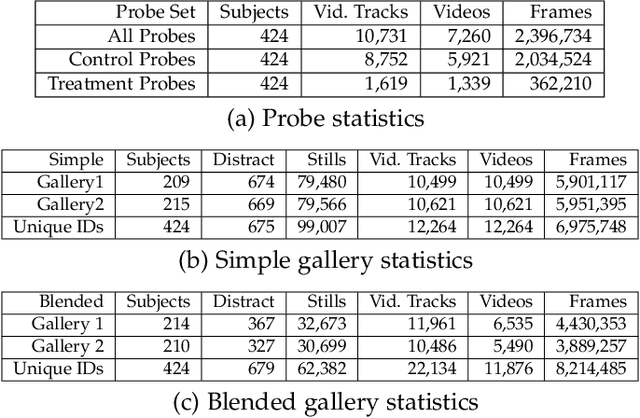
We address the problem of whole-body person recognition in unconstrained environments. This problem arises in surveillance scenarios such as those in the IARPA Biometric Recognition and Identification at Altitude and Range (BRIAR) program, where biometric data is captured at long standoff distances, elevated viewing angles, and under adverse atmospheric conditions (e.g., turbulence and high wind velocity). To this end, we propose FarSight, a unified end-to-end system for person recognition that integrates complementary biometric cues across face, gait, and body shape modalities. FarSight incorporates novel algorithms across four core modules: multi-subject detection and tracking, recognition-aware video restoration, modality-specific biometric feature encoding, and quality-guided multi-modal fusion. These components are designed to work cohesively under degraded image conditions, large pose and scale variations, and cross-domain gaps. Extensive experiments on the BRIAR dataset, one of the most comprehensive benchmarks for long-range, multi-modal biometric recognition, demonstrate the effectiveness of FarSight. Compared to our preliminary system, this system achieves a 34.1% absolute gain in 1:1 verification accuracy (TAR@0.1% FAR), a 17.8% increase in closed-set identification (Rank-20), and a 34.3% reduction in open-set identification errors (FNIR@1% FPIR). Furthermore, FarSight was evaluated in the 2025 NIST RTE Face in Video Evaluation (FIVE), which conducts standardized face recognition testing on the BRIAR dataset. These results establish FarSight as a state-of-the-art solution for operational biometric recognition in challenging real-world conditions.
NTIRE 2025 Challenge on Day and Night Raindrop Removal for Dual-Focused Images: Methods and Results
Apr 19, 2025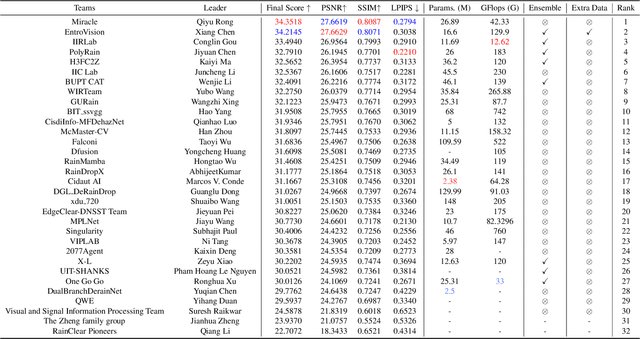
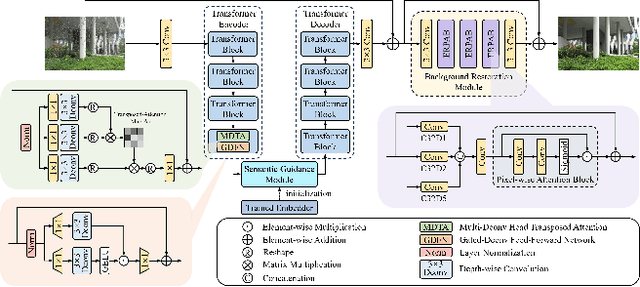
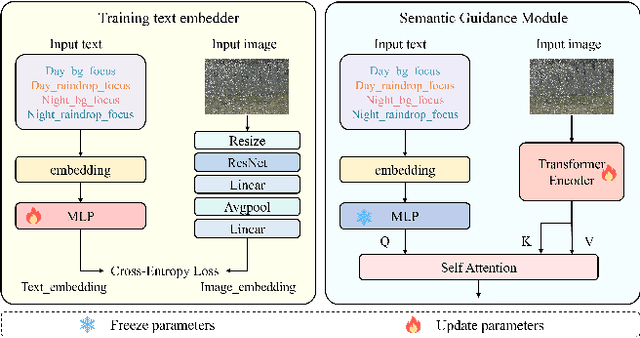
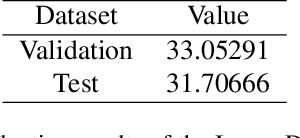
This paper reviews the NTIRE 2025 Challenge on Day and Night Raindrop Removal for Dual-Focused Images. This challenge received a wide range of impressive solutions, which are developed and evaluated using our collected real-world Raindrop Clarity dataset. Unlike existing deraining datasets, our Raindrop Clarity dataset is more diverse and challenging in degradation types and contents, which includes day raindrop-focused, day background-focused, night raindrop-focused, and night background-focused degradations. This dataset is divided into three subsets for competition: 14,139 images for training, 240 images for validation, and 731 images for testing. The primary objective of this challenge is to establish a new and powerful benchmark for the task of removing raindrops under varying lighting and focus conditions. There are a total of 361 participants in the competition, and 32 teams submitting valid solutions and fact sheets for the final testing phase. These submissions achieved state-of-the-art (SOTA) performance on the Raindrop Clarity dataset. The project can be found at https://lixinustc.github.io/CVPR-NTIRE2025-RainDrop-Competition.github.io/.
Digital Staining with Knowledge Distillation: A Unified Framework for Unpaired and Paired-But-Misaligned Data
Apr 14, 2025Staining is essential in cell imaging and medical diagnostics but poses significant challenges, including high cost, time consumption, labor intensity, and irreversible tissue alterations. Recent advances in deep learning have enabled digital staining through supervised model training. However, collecting large-scale, perfectly aligned pairs of stained and unstained images remains difficult. In this work, we propose a novel unsupervised deep learning framework for digital cell staining that reduces the need for extensive paired data using knowledge distillation. We explore two training schemes: (1) unpaired and (2) paired-but-misaligned settings. For the unpaired case, we introduce a two-stage pipeline, comprising light enhancement followed by colorization, as a teacher model. Subsequently, we obtain a student staining generator through knowledge distillation with hybrid non-reference losses. To leverage the pixel-wise information between adjacent sections, we further extend to the paired-but-misaligned setting, adding the Learning to Align module to utilize pixel-level information. Experiment results on our dataset demonstrate that our proposed unsupervised deep staining method can generate stained images with more accurate positions and shapes of the cell targets in both settings. Compared with competing methods, our method achieves improved results both qualitatively and quantitatively (e.g., NIQE and PSNR).We applied our digital staining method to the White Blood Cell (WBC) dataset, investigating its potential for medical applications.
Training-Free Text-Guided Image Editing with Visual Autoregressive Model
Mar 31, 2025Text-guided image editing is an essential task that enables users to modify images through natural language descriptions. Recent advances in diffusion models and rectified flows have significantly improved editing quality, primarily relying on inversion techniques to extract structured noise from input images. However, inaccuracies in inversion can propagate errors, leading to unintended modifications and compromising fidelity. Moreover, even with perfect inversion, the entanglement between textual prompts and image features often results in global changes when only local edits are intended. To address these challenges, we propose a novel text-guided image editing framework based on VAR (Visual AutoRegressive modeling), which eliminates the need for explicit inversion while ensuring precise and controlled modifications. Our method introduces a caching mechanism that stores token indices and probability distributions from the original image, capturing the relationship between the source prompt and the image. Using this cache, we design an adaptive fine-grained masking strategy that dynamically identifies and constrains modifications to relevant regions, preventing unintended changes. A token reassembling approach further refines the editing process, enhancing diversity, fidelity, and control. Our framework operates in a training-free manner and achieves high-fidelity editing with faster inference speeds, processing a 1K resolution image in as fast as 1.2 seconds. Extensive experiments demonstrate that our method achieves performance comparable to, or even surpassing, existing diffusion- and rectified flow-based approaches in both quantitative metrics and visual quality. The code will be released.
Reconciling Stochastic and Deterministic Strategies for Zero-shot Image Restoration using Diffusion Model in Dual
Mar 03, 2025Plug-and-play (PnP) methods offer an iterative strategy for solving image restoration (IR) problems in a zero-shot manner, using a learned \textit{discriminative denoiser} as the implicit prior. More recently, a sampling-based variant of this approach, which utilizes a pre-trained \textit{generative diffusion model}, has gained great popularity for solving IR problems through stochastic sampling. The IR results using PnP with a pre-trained diffusion model demonstrate distinct advantages compared to those using discriminative denoisers, \ie improved perceptual quality while sacrificing the data fidelity. The unsatisfactory results are due to the lack of integration of these strategies in the IR tasks. In this work, we propose a novel zero-shot IR scheme, dubbed Reconciling Diffusion Model in Dual (RDMD), which leverages only a \textbf{single} pre-trained diffusion model to construct \textbf{two} complementary regularizers. Specifically, the diffusion model in RDMD will iteratively perform deterministic denoising and stochastic sampling, aiming to achieve high-fidelity image restoration with appealing perceptual quality. RDMD also allows users to customize the distortion-perception tradeoff with a single hyperparameter, enhancing the adaptability of the restoration process in different practical scenarios. Extensive experiments on several IR tasks demonstrate that our proposed method could achieve superior results compared to existing approaches on both the FFHQ and ImageNet datasets.